Showing posts with label cartoon. Show all posts

Friday, May 20, 2016

Why We Bare Bears Succeeds As A Comedy


Even after having only aired seven episodes and a handful of promos, We Bare Bears is already looking to be one of the more prominent cartoons of the modern age, which is really saying something considering that we currently live in what many consider the new Golden Age of cartoons, with the likes of Adventure Time, Steven Universe and My Little Pony: Friendship is Magic dominating the landscape.  There’s plenty to talk about with this show, considering the stellar voice acting, smooth, yet charmingly simple animation and catchy soundtrack.  But, what has really caught my attention thus far is just how side-splittingly hilarious it is.  Cartoons may not be my specialty when it comes to observation and critiquing, but I still know a good comedy when I see one.  Here’s why I think it’s so funny.


1. The Diverse Personalities of the Three Bears
As the main focus of the show, Grizz, the grizzly bear, Panda, the panda bear, and Ice Bear, the polar bear (all of whom are brothers), spend most of their time interacting with one another, so the best way to create memorable interactions between each bear is to give them each a personality that really stands out, which We Bare Bears nails down perfectly.  First, there’s Grizz, the unofficial leader of the trio.  Certainly the most outgoing of the three, Grizz comes off as very assertive and vocal in his opinions.  He’s always excited to interact and make new friends whenever he gets the chance and tends to initiate many of the adventures that the three find themselves in, such as suggesting that they start their own food truck upon realizing that Ice Bear is a tremendous cook in the eponymous episode “Food Truck” or deciding to get “revenge” on their new friend Chloe after they discover a report she did on them painted them in a rather negative light.
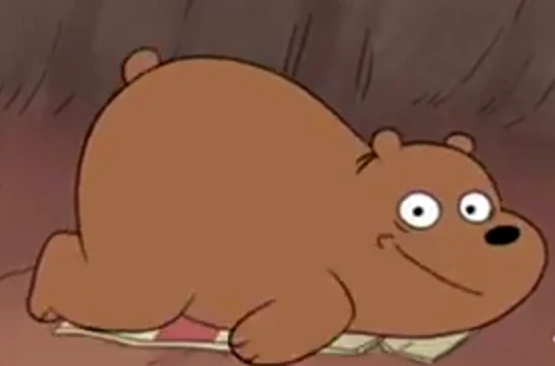

Unfortunately, his vibrant personality does little to cover up his rather comical flaws.  This expressiveness tends to leak into his less appealing traits, causing him to be a bit of a slob and rather glutinous, best showcased by his eating display in “Burrito” where he manages to swallow whole burritos in a matter of seconds.  He also doesn’t tend to think many of his plans through very thoroughly, as he fails to take into account the repercussions of feeding wildlife in “Food Truck” or the outcome of his plot against Chloe, leading to a series of mishaps that ends up causing the collapse of his entire plan.  None the less, he still remains a very likely character, as he’s more than willing to learn from his mistakes, stay optimistic to the very end and never forgets that he always has Ice Bear and Panda by his side.


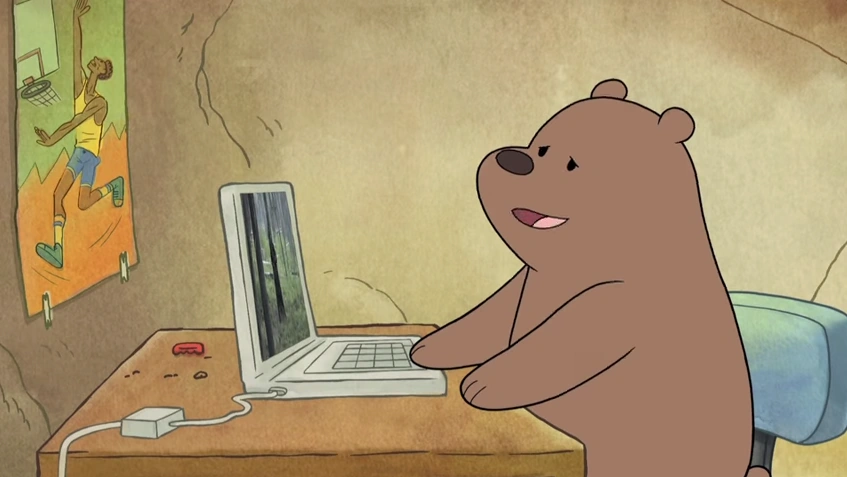
Speaking of Panda, his personality can sort of be seen as the antithesis to Grizz’s.  A rather shy individual, Panda is the least outgoing and most sensitive of the three, more comfortable with following Grizz’s command than thinking of ideas on his own.  This sensitivity has lead to him being labeled the frailest of the three, not only physically, what with him getting injured from merely having a basketball thrown at him in “Our Stuff” and showcasing a severe peanut allergy in “Panda’s Date”, but also mentally, as even a mouse that finds its way onto Panda’s laptop in “Everyday Bears” frightens him, causing him to use up most of the day coming up with convoluted ways to capture the mouse instead of simply trying to grab it or scare it away.

That’s not to say that Panda doesn’t have his strong sides.  Not only is he a skilled artist, specializing in Anime, but he is also quite tech-savvy, spending many hours on his laptop or IPhone, sometimes even managing to use this to assist the trio, such as using a phone tracking application to find their lost backpack in “Our Stuff”.  And while his sensitivity can be seen as a weakness, he also tends to use it to his advantage.  He has a very tender, comforting side and has far less trouble keeping his emotions and judgment separated than Grizz does.  When pushed, he is more than willing to stand up for himself and note that something is wrong, like when he calls Grizz out for his obsession with food in “Burrito”.  He also has a romantic side, as he is always on the lookout for a girlfriend, although his meek side tends to cause his attempts to fall apart more often than not, such as his unsuccessful attempt to have a one-on-one date with Lucy, a new friend of the bears who saved Panda from an allergic reaction while trying desperately to keep his brother’s out of the picture.  Panda is certainly timid, but that doesn’t stop him from being rather amiable at times.


And then there’s Ice Bear…where do you start with this guy?  Ice Bear is typically seen as the comic relief of the show.  This is because he tends to be very quiet most of the time, letting Panda and Grizz do the talking.  However, when he does speak or interact, it’s a whole new ball game.  Not only does he talk strictly in third person, but his actions are downright bizarre.  He’ll tend to roll around for no real reason, say incredibly awkward phrases in the few instances where he speaks (“Ice Bear smells like clean babies.”) and will even cut his food with his own fire axe, all while maintaining a stoic, emotionless expression and voice tone while doing these things.  Saying that he’s the strangest of the three bears is more than a bit of an understatement.

But, if you pay close attention to his action during the show, you’ll find that they speak far louder than his words.  He may have a limited vernacular, but his skill set far surpasses his brothers’.  On top of his excellent cooking skills, he also cleans the house on a regular basis, knows martial arts, speaks multiple languages and even has a bit of an engineering background, as proven in “Everyday Bears” when he manages to reprogram a Roomba he ordered online after it malfunctions, even though it does goes on a destructive rampage shortly after.  Taking all of this into consideration, Ice Bear may not come off as the most outgoing or vocal of the trio, but his actions can certainly label him as the most responsible.

And yet, the best part of their personalities is not just how distinct they are, but how they juxtapose one another when the three interact.  Grizz’s assertiveness can, more often than not, lead to him taking things too far, such as his persistent attempts to become an internet celebrity, typically leading to him being scorned by Panda.  Panda’s bashfulness causes him to stand out like a sore thumb when compared to the levelheadedness of his brothers.  And I think it’s safe to say that Ice Bear’s antics stand miles above anything Panda or Grizz can dish out.  But despite their differences, they still manage to learn from their mistakes and come together as brothers should in the end, which not only warms the heart, but serves to solidify their relationship in all its awkward glory.


2. Well-Rounded Humor
As for the jokes themselves, there’s a solid blend of physical and verbal humor, but it also helps that the jokes are well-paced, never dishing them out so fast that we feel suffocated or just plain annoyed by them.  We’re given a second or two to breathe after the punch line and then they move on with the narrative.  Furthermore, the jokes actually have a sense of purpose to them.  Never does it feel like we’re entering a Family Guy or Uncle Grandpa scenario where the writers are just throwing out random thoughts off the top of their heads and seeing how the characters react to them.  Every time they crack a joke, it feels directly related to both the setting of the episode and the traits of each character.

Take, for example, the early goings of “Everyday Bears”.  Grizz goes to check the mail, but then notices several humans playing with a frisbee, immediately enticing him to join in.  Meanwhile, Panda is surfing the web in his room, checking out various Facebook posts and what have you.  The joke here is that every once in a while, it will cut to a behind shot of Panda and the window in his room, where we can see the Frisbee being thrown outside while Grizz cheers them on.  Not only does this joke showcase the vastly different routines of the individual bears, but it also plays off of their established character traits, Grizz being more outgoing and Panda being more reserved.

And what’s even better is that these types of jokes are always balanced perfectly between kid’s humor and adult humor.  The bears are constantly interacting with their surroundings in real-world scenarios, leaving plenty of potential for very generalized humor, but the execution is what sells it.  The three tend to find themselves involved in wacky shenanigans, giving kids something to laugh at, but they never do it in an overly-cutesy manner.  They simply handle the situation as normal people with these traits would.  It’s this type of well-rounded humor that always keeps me coming back for more.

3. It’s Relatable
Arguably the most defining feature of We Bare Bears’ comedy stems from the aforementioned real-world scenarios.  The best type of humor is not just jokes that you understand on a technical level, but references to things that you feel like you can understand on a personal level.  Because they avoid delving into fantasy elements or focusing on over-the-top cartoonish antics a la Tom & Jerry, the viewer is able to more closely associate with the various scenarios in each episode, as well as the defined personalities of each bear.

From what we’ve seen so far, the bears have gone on an adventure to reclaim their stolen property, attempted to become internet celebrities, tried to start their own business, had rather complicated relationships with multiple human friends and simply went about their normal routines.  Antics are thrown into the mix in order to give the episodes comedic flair, but the context still remains.  These are all events that could realistically happen to you or me at one point or another.  And because we could see ourselves in the shoes of the bears, the humor is magnified because of our greater understanding of it.

There are also valuable lessons to be learned at the end of most episodes, adding on the realistic nature of the characters and their undertakings.  A good number of these lessons stem from the personal flaws of one or more characters, such as Panda’s bashfulness leading to him shutting out his friends in an attempt to get closer to Lucy instead of simply being honest with them or Grizz’s determination clouding his judgment in his quest to become famous on the internet.  In the end, they always tend to learn from their mistakes and become better people…er, bears as a result.  These character evolutions allow us to continue to relate to the bears, causing us to be more closely affected by the humor, not to mention that the lessons concern topics that anyone, not just children, can appreciate and learn from.

Yes, you're probably going to cry over a grizzly bear falling in love with a giant burrito.
And even the inclusion of some drama can actually benefit the humor.  Going back to the episode “Burrito”, Grizz falls madly in love with a giant burrito, only coming to his senses in the end when the burrito explodes after being struck by lightning during a storm and his friends help him realize that they’re far closer to him than food could ever be.  However, it is revealed in a flashback at the end of the episode that Grizz actually got stuck at the top of a tree as a cub during another lightning storm, only to be saved by grabbing on to a fireman’s arm, which just so happens to have a portion of his uniform that looks very close to the giant burrito, meaning that Grizz subconsciously felt attached to the burrito because of its similarities to the very thing that “saved” him and comforted him as a cub.

On top of being surprisingly heart-breaking for this type of show, this drama makes Grizz feel more alive, more realistic as a character.  The fact that he has been shown to have subconscious trauma from his past is, again, something that the average person could associate with, allowing them to relate back to him more easily.  And conversely, the show’s humor makes them more likable, amplifying the effectiveness of the drama because we care more for the characters.  What all of this boils down to is that Grizz, Panda and Ice Bear, even with their exaggerated traits and the fact that they’re anthropomorphic bears, simply feel like real people.  Because of that, we are able to understand and appreciate the humor that much more.

And when all three of these elements come together, they create what I find to be one of the funniest, surprisingly touching cartoons I’ve seen in a long time.  The well-rounded humor is one thing, but when you throw in a cast of relatable, diverse and loveable characters like the bears, We Bare Bears shows that it’s something special.  It actively fuses the humor and characters into one plane and allows the writing to flourish as a result, using the jokes as a way to make the protagonists more engaging; not just as a tool to advance the plot and get some cheap laughs.  This show is a testament to what happens when writers really put their hearts and souls into a product and I can’t wait to see where it goes from here.

Thursday, February 19, 2015

Ratchet and Clank Review


Back in my youth, as was the case for many gamers, my gaming was limited to what I could scrounge up from my parents with chores, Christmas, birthdays and just sheer luck.  I needed to prioritize what consoles were essential for me to obtain and which I could sacrifice, at least for the time being.  The PS2, unfortunately, didn’t make the cut.  I was more than aware that there were plenty of great games for it at the time, but I wasn’t exactly in any position to bitch about any games that came my way.  That being said, thanks primarily to the PS2 Collection games available on the PS3, I’ve been able to try out these gems from console generations past, leading to plenty of memorable experiences that showed me just what I was missing out on all this time.  And Ratchet and Clank is absolutely not an exception by any means.  The first in a long series of cartoonish sci-fi action adventure games, Ratchet and Clank feels special from the first moment that you start playing, gloriously melding together freedom and variety; combat and platforming; comedy and personality.  Even if it does have some glaring issues from time to time, Ratchet and Clank contains so many great elements that any gamer, from casual to veteran, can appreciate.

                The setting and plot of Ratchet and Clank alone will remind you that this is not the type of game that will be taking itself very seriously.  In a highly futuristic alternate universe, the alien civilization known as the Blarg, led by Ultimate Supreme Executive Chairman Drek (Can you tell that he’s in charge?), is attempting to create a new, pristine planet out of other planets by conquering and stealing portions of them , as their planet has become highly polluted and uninhabitable.  While on the war path, a robot manufacturing station run by Drek accidentally produces a miniature version of their usual product, who manages to view an Infobot, small hovering robots that produce TV screens to deliver short messages, which reveals Drek’s plans and motivates him to escape the plant by hijacking a space ship in order to stop Drek.  He doesn’t get far, however, as he is soon shot down by Drek’s minions over a desert planet which is inhabited by our other protagonist, Ratchet.

                Ratchet is working on his own ship as he witnesses the small robot’s ship crash-land near his garage.  Upon rescuing the robot, which Ratchet soon names Clank, Clank informs Ratchet of the impending threat to galactic life and, with a bit of persuasion and promising to power Ratchet’s ship, Ratchet goes along with their plan, which includes gaining the help of Captain Qwark, a supposed galactic hero, and finding strong enough equipment to take on Drek and end his plans.  The story is nothing to write home about, but this is all forgivable because of the tounge-in-cheek nature of the game.  And sure, the plot is fine and dandy, keeping things short and simple, but the real allure comes from the characters and Ratchet and Clank’s sense of humor. 

The writing manages to come off as both quick and clever, never wanting to keep you too long from the action, but still getting a couple of chuckles out of the player, even if some of the cutscenes are a tad long-winded.  But, the characters are what really allow the comedy to flourish.  Each character, both primary and secondary, is full of personality, bolstered by stereotypes, but never defined by them.  They feel like real people (or aliens, whatever), but still have a note of silliness behind them to really take jokes home, while never reaching for a laugh and coming off as obnoxious.  On top of that, Ratchet and Clank make quite the duo, as Ratchet is the brash, strong-willed type that encompasses many of the tropes of that of a 90’s cartoon character, while Clank is quite polite and articulate, if not somewhat naïve.  Together, the two juxtapose each other perfectly, allowing one another’s strengths to make up for the other’s flaws.  Unfortunately, Ratchet can be pretty selfish and a bit of an ass in the middle of the game, but he thankfully overcomes this behavior in the end and his dickishness does little to hinder the loads of laughs that Ratchet and Clank contains.
"Hello.  I'm useless.  And you are?"
However, we’re not dealing with a cartoon here.  There’s a lot more to video games than cracking a few jokes, but the game is more than capable of holding its own in those areas as well.  For starters, the graphics and music perfectly compliment the light-hearted, cartoonish tone of the game.  Ratchet and Clank’s soundtrack is a catchy mix of jazzy, electronic and orchestrated elements; the former two when it comes to beat-‘em-up sequences and platforming and the latter in more dramatic moments.  This helps to create the perfect atmosphere for both types of environments, especially when you’re beating the hell out of mooks and you need something energetic to liven up the mood.  As for the graphics, they liven the world up in a whole different fashion. 

They’re expectedly stylized and cartoonish, but not something you would expect out of the likes of Uncle Grandpa.  Each level is colorful and vibrant, but conserved, not only relying upon bright distractions to catch our eyes temporarily.  The layout certainly feels animated, but equal time was given to structuring the world to give each level its own personality, whether it’s a city filled to the brim with towering skyscrapers or the Blarg’s hyper-polluted planet, littered with abandoned laboratories and literal ponds of toxic sludge.  It really runs along the same lines as the writing, in that it offers a lot of flare, but never feels obnoxious.  Simply put, the levels are both cartoonish and atmospheric, allowing them to have both an immediate and lasting appeal that, as far as I’m concerned, never outstays its welcome.

But all of these elements only serve as the backdrop for the big star of Ratchet and Clank: the gameplay.  Starting with Ratchet’s controls, they feel smooth enough, but do take some getting used to, as turning while moving can feel somewhat sluggish at times.  The same goes for jumping, due to the double jump that gimps Ratchet’s momentum, but it can actually come in handy when you realize that it can be used for more precision platforming, not to mention that he can cling to the edge of platforms.  Again, it does take some getting used to, but it’ll feel natural with an hour.  Likewise, utilizing weapons is the same deal, at least with long-range weapons.  Melee weapons, such as Ratchet’s wrench, have a good amount of range and speed behind them, but machine guns like the Blaster feel kind of clunky initially.  You can run-and-gun and enemies will be locked on to, if you’re close enough, or Ratchet can enter a first-person mode, disabling movement but allowing for far more precision.  Locking on isn’t always as precise as you’d like it to be, so it really comes down to whether you want to sacrifice accuracy or mobility.  But again, within the first couple of levels, these issues should become a thing of the past, especially since you can always develop your own strategy with the weapons and gadgets the game gives you, and hoe-lee shiiiit do they give you a lot.

Over the course of Ratchet and Clank, you are given access to a total of 15 weapons and 14 gadgets, each with their own purpose and ability to mix up the gameplay.  The weapons are all ridiculously campy in their design, such as a massive boxing glove (The Walloper) and the R.Y.N.O. (Rip You a New One), a heat-seeking rocket launcher, but what is even more glorious is just how much they can accomplish.  You have your traditional short and long-range weapons, including flame throwers and rocket launchers, but you can also use the Suck Cannon to suck up smaller enemies and use them as projectiles, the Decoy Glove to set up a blow-up doll of Ratchet to distract enemies and attack them from behind, the Tesla Claw to electrify enemies with a bolt of lightning that tracks them, the Glove of Doom to shoot out tiny mechs that run up to enemies and blow up on contact…I think you get the picture.
Take your pick, gentlemen.

Because of just how versatile Ratchet’s arsenal is and how effective all his weapons can be, the player is free to tackle groups of enemies in practically any way they see fit.  You can go in guns blazing, keep your distance and pick them off one at a time or, hell, even simply distract them in order to sneak by them, if you so choose; the choice is yours.  Not only does this keep combat fresh and exciting, but it  means that replay value is through the roof.  Furthermore, each level has a number of collectable Gold Bolts which, when spent alongside a certain number of regular bolts (Ratchet and Clank’s currency), can be used to purchase upgraded versions of your weapons, although they’re only available after you’ve beaten the game or in a hidden area near the end of your first playthrough.  Unfortunately, as great as all of this stuff is, the gadgets just don’t have the same amount of versatility.

First off, let’s get one thing straight: the gadgets are all useful in their own right.  Their purposes vary from transportation to solving puzzles to just easing the player’s journey.  The Heli-Pack and Thruster-Pack, which allow Clank to levitate Ratchet and help him cover more distance, and the Hydro-Pack, which allows Ratchet to rocket through underwater segments, are all massive helps when it comes to traversing the levels, but they’re pretty much the only ones in the game that don’t feel completely situational.  Any other gadget can only be used when a special circumstance calls for it.  You’re given Grind Boots to grind on rails, but you’re only given rails to grind during special level sequences made up of nothing but rails.  You get a hover board, but can only use it for a whopping two racing minigames. 

But the worst offender is the Hydrodisplacer, which is basically a glorified Super Soaker that can suck up massive amounts of water from flooded areas so that you can explore them.  Literally all you do with it is walk up to a vent specified for the gadget, stick it in there to either suck up or deposit water and THAT’S IT.  Now, I understand that sometimes gadgets are only needed for one specific purpose, but what I’m getting at is this: why couldn’t more gadgets be given more versatile functions?  Wouldn’t it be awesome to grind around levels and shoot at enemies a la Infamous?  What about using the magnetic boots you receive to walk up any wall you choose, instead of one specific twisting ramp way?  How about allowing us to use the Sonic Summoner, a helmet that summons a small spaceship that can assist you with eliminating enemies, whenever we want, at the cost of some bolts, instead of only at specified stations?  The gadgets may share the same levels of goofy charm as the weapons, but damned if they don’t reek of unrealized potential.

Thankfully, the same can’t be said for Ratchet and Clank’s level design.  Aside from looking vibrant and full of energy, what so alluring about the level design is that each world is never the same as the last.  Granted, you’ll have your minigames, your combat sections and your platforming sections, but the way they are all spread out is never even remotely similar to any level before or after it.  Some levels may be entirely linear, while others have a hub area with paths to smaller sections that contain various mission objectives.  Some levels have multiple pathways to the same objective and it’s up to the player to decide which to take, while other are seemingly linear, but have small side routes that give an added sense of depth to the levels.  And that’s just getting into their general structure.
Every one just has so many nuances that break up the gameplay and really give each one its own identity, making it more than just another stage that they needed to fill a quota.  The enemy variety is simply fantastic, as it doesn’t just throw the same old groups of quick, little creatures that distract you while trying to deal with the bigger, gun-toting enemies.  Each world features a new type of enemy, constantly evolving their strategies at a gradual pace to make each encounter more difficult, forcing the player to rethink their strategies and utilize all the weapons at their disposal.  The platforming sequences are structured nicely as well, always feeling perilous and exhilarating, yet still giving you moments to get your bearings and plan your next move.  There’s always a steady variety of side missions where you control Clank or a vehicle (which control perfectly, I might add) to break up the jumping and gunning.  Even the bosses are fantastic, although they tend to be few and far between, with their strategies constantly changing throughout the battle, making things far more intense than simply fighting some super huge mook.  Honestly, it’s pretty hard to articulate just how much these levels have to offer.  The best way to truly appreciate them is to play them first hand. 

That’s not to say that I don’t have a few problems with their overall setup.  I do find that the checkpoints can feel relatively scarce at times and the use of the breakable crate trope can make the game a tiny bit tedious at times.  The difficulty can also be somewhat inconsistent (I’m lookin’ at you, Planet Orxon!), as some levels will throw a ridiculous amount of enemies at you, all for the sake of begetting an artificial sense of challenge, but only coming off as cheap garbage.  However, my biggest problem comes from bolt collection, specifically concerning my ability to afford new weapons that are made available in the store. 
All right, are you f**king kidding me!?

For the first half of the game, they are given out at a fair pace, as long as you’re willing to earn them.  But as time goes on, weapons become a lot more expensive, but not only are enough bolts not made available from either breaking crates or killing enemies, but there is no realistic, practical way to grind for them, save moving on to the next level or killing the same groups of enemies over and over for the same measly amount of bolts.  In this case, you’re forced to either forgo the new weapons or actually sacrifice buying ammo and rely upon that which you can find throughout the level.  As you can imagine, this becomes a HUGE source of frustration in the later levels, as you’re going to need as much ammunition as humanly possible, so having to deny myself that for a weapon that may or may not be useful can drive me pretty close to wanting to smash a controller or two.  Maybe I just got unlucky for some reason, but this is exactly what we have testers for.  When you’re basing your gameplay heavily around gunplay and I’m unable to use these guns when I really need them, we’ve got ourselves quite the issue.

But even with a couple of bumps in the road, Ratchet and Clank serves as a reminder that a little bit of variety and freedom can go a long way.  Along with the quick-witted writing style and beautiful graphics, the amount of possibilities given to the player in combat and each level having its own unique style make this game an instant classic, even 13 years after its release.  I do get the sense that some portions feel experimental, as if the developers were simply trying to figure out what works and what doesn’t for this series, what with the underutilized gadgets and several pace-breaking moments caused by the inconsistent bolt collection, but these do little to hamper the fun factor that can be felt so many times during the game.  If you haven’t played this already, do yourself a favor and get your hands on it immediately.  God only knows I’m already pumped to start the sequel.